Showing posts with label From the Source. Show all posts

Monday, April 8, 2013

“It’s not the food in your life, it’s the life in your food”- B’Gabs


Post written by CHC Member Thu Nguyen

Thu serves at Respiratory Health Association as an asthma educator


Obesity, in an energy balance perspective, is a result of more energy in than out. Excessive energy in + little energy out = weight gain. The challenge here is that it is so easy to consume energy, and so much more difficult to expend energy. It takes me 15 minutes to chow down on a burger that is around 500 calories. Consequently, I would have to spend at least an hour in the gym to expend that much energy. Therefore, it is pertinent that we make healthy choices when it comes to the food we put in our body. We want to make sure the calories we consume come from foods that are packed with nutrients, vitamins, and fiber that will offer us satiety, and not foods that offer empty calories.
Photo of my burger
Unfortunately, there are many misconceptions with healthy food. Many people think eating healthy is a punishment because they associate healthy food as bland or tasteless. However, after our hard work at Experimental Station last week, some Chicago Health Corps members visited B’Gabs Goodies Raw Vegan Deli for lunch. B’Gabs offer high quality, soy and gluten-free vegan food. It was my first time trying a vegan hamburger, and I was very pleased. B’Gabs lives up to their philosophy by showing that healthy food is indeed flavorful and tasteful. My burger wasn’t a typical burger, but it tasted as delicious as a typical burger. If you’ve never tried vegan food, you are missing out! I guarantee you will physiologically get more for your money!  Whether you choose to eat vegan or not, just remember healthy food does taste good. Visit http://www.eatingwell.com/ for healthy and delicious recipes you can make at home!

Visit B’Gabs Goodies Raw Vegan Deli: http://bgabsgoodies.com/

Thursday, March 28, 2013

The Question Box


Post written by CHC Member Suzanne Williams

Suzanne serves at Erie Family Health as a Health Educator
“If you have sex twice in one day, does that mean you’ll get pregnant and have two babies later?”  

This  is one example of the many questions that I receive when teaching Teen Pregnancy Prevention courses (TPP) in Chicago Public Schools.  TPP is a series of four classes that are taught to elementary, middle, and high school students all over Chicago by AmeriCorps members serving with Erie Family Health Center. This course utilizes lessons from the evidence-based Family Life and Sexual Health (FLASH) curricula and focuses on teaching students about healthy relationships, anatomy and reproduction, contraception, and sexually transmitted infections. Erie health educators have taught TPP courses to over 800 students all around Chicago!

My favorite part of teaching TPP is the QUESTION BOX! At the beginning of each session, we hand out small slips of paper and explain to the students that they can write an anonymous question or comment about ANYTHING to be answered at the beginning of the next class. We collect the slips of paper from all students, so that no one can figure out who asked what question. I love using the question box because it gives students an open forum to address their questions and concerns without fear of being judged by their classmates or going through the awkwardness of asking a parent or teacher. It is a safe way for students to ask whatever is on their mind. The question box is also a great way for health educators to assess their understanding and to determine difficult concepts that should be re-taught to the class. The question box is a great tool to use in all sex-ed classroom sessions!

Tuesday, February 19, 2013

Serving a Balanced Education – CVCA’s Food Education Program


Post written by CHC member Chinwe Ntamere

Chinwe serves with the American Cancer Society as a Health Educator


The National School Lunch Program was introduced in 19461 as a program that provides breakfast and lunch to children who may otherwise have nothing to eat.  It has become the second largest food program in the U.S., spending $8 billion annually and feeding an average of 30 million children a day1,2. Recently, some have argued that it lacks in both education and nutritional benefits, citing recent studies linking school lunches with a higher risk of obesity3,4,5.

At a recent in-service day, Chicago Health Corps and Healthy Communities Corps visited the Chicago Vocational Career Academy (CVCA), where educators promote healthier student lunches, while also expanding student career options. As part of the Chicago Public Schools’ Culinary and Hospitality Career and Technical Education Program, students have the opportunity to gain food service certification and food preparation experience while in school. Students take an active part in creating school lunches that meet their taste, while fitting within the school’s nutritional and budgetary requirements. These are skills that the students can transfer to their own lives, encouraging them to actively think about the role of food in their own health.

David Blackmon, the Executive Director of the CPS Culinary Arts and Hospitality Program, argues that more programs like these should be offered to students, especially in lower income communities where access to healthy foods and job opportunities are limited. By providing students with career skills before college, they have the option of either entering the work world directly after graduation or entering college with a better understanding of what career path they want to follow.

At the Chicago Vocational Career Academy, they believe that all elements of the school day, whether it is the curriculum or lunch menu, should provide the students with tangible life skills. By encouraging active student participation in lunch preparation, they have empowered students to take control of their own health and nutrition, ensuring there are educational opportunities in the debated school lunch program.

1.      Committee on Nutrition Standards for National School Lunch and Breakfast Programs, National Research Council. (2008). Nutrition Standards and Meal Requirements for National School Lunch and Breakfast Programs: Phase I. Proposed Approach for Recommending Revisions. (V. A. Taylor, Ed.) Institute of Medicine of the National Academies. From NAP: http://www.nap.edu/catalog/12512.html
2.      Black, J. (2011, February 24). School Lunch Is Not the Answer: Improving school food is only a small step toward reducing childhood obesity. Retrieved February 9, 2013, from Slate: http://hive.slate.com/hive/time-to-trim/article/school-lunch-is-not-the-answer
3.      RABIN, R. C. (2011, February 4). Childhood: Obesity and School Lunches. Retrieved February 9, 2013, from New York Times: http://www.nytimes.com/2011/02/08/health/research/08childhood.html?_r=0
4.      Millimet, D., Tchernis, R., & Husain, M. (2010). School Nutrition Programs and the Incidence of Childhood Obesity. Journal of Human Resources , 45 (3), 640-645.
5.      Park, E., & Graziano, M. (Directors). (2010). Lunch Line [Motion Picture]. United States: UJI Films. From UJI Films: http://lunchlinefilm.com/

Tuesday, January 22, 2013

Why Children Need Nature


Post written by CHC member Sydney Weydemeyer

Sydney serves at the Seven Generations Ahead as the  Fresh From the Farm Program Associate & Truck Farm Chicago Co-Director


If you think back to your day, how much of it was spent outside?  Recent research shows that when children don't spend time outdoors, their mental and physical happiness is measurably compromised (Louv 2008). Spending time outside has been found to reduce ADHD symptoms, cultivate problem solving capabilities, increase concentration and self discipline, and develop creativity in children.  (Louv 2008; Taylor 2001, 2002, 2004, 2009)

Sometimes, children can't spend time outside. In some cases, their neighborhood might be too dangerous or there may be no access to a “green” outdoor space. But research argues that even a view of a few trees and grass from an apartment has been found to increase girls' self discipline and coping abilities (more girls in this study were spending time indoors compared to boys, so there was only a measurable increase in girls; see research for more information). For more information on the research supporting children spending more time outside, check out 
Richard Louv's book "Last Child In the Woods,"  Dr.Andrea Faber Taylor's research at U of I Urbana-Champaign, and Chicago Wilderness.

In my position at
Seven Generations Ahead, I spend much of my time teaching children outside. One day I hope that time spent outdoors will be a requirement at school, just as school lunch and physical education are required. Until then, I'm going to take every opportunity to bring my students outside.

Tuesday, January 15, 2013

Meet John Doe...


Post written by CHC member Daniel Broome

Daniel serves at the American Cancer Society at Stroger Hospital as a Patient Navigator 


I remembered my first day of serving when I saw a quote on a statue in front of Old Cook County Hospital by Louis Pasteur:

"One doesn't ask one who suffers: What is your country and what is your religion? One merely says, You suffer, this is enough for me, you belong to me and I shall help you."

This quote accurately defines the mission of John H. Stroger, Jr. hospital and my term of service with Chicago Health Corps.  Serving in the Radiation Department with the American Cancer Society (ACS) here at Stroger, I assist the patients in overcoming barriers to care. Generally, this means we help patients find or pay for transportation.  Other assistance we provide include housing resources, homecare assistance, and on occasion, ordering or paying for nutritional supplements. All of this is done by generous donation to ACS.

One of our patients, Mr. John Doe, is a 48 year old man who is being treated with radiation therapy. In September of this year, he had a tracheotomy to provide a surgical opening into the windpipe to act as an airway and to remove fluid from his lungs. He suffers from chronic obstructive pulmonary disease (COPD), sleep apnea, chronic pain, and can no longer speak.

He gets most of his caloric intake by nutritional supplement – 6 cans of Ensure a day, fed through a tube.

The week before Christmas, Mr. Doe’s supply of Ensure was running low. He reminded me that he had not received the new shipment of Ensure. I could tell he was becoming desperate. I saw Mr. Doe the next morning and expected to see frustration on his face. Instead Mr. Doe wrote out a gracious note to me, thanking me for my help, and telling me he would find a way to last until the company delivered his supplies.
I was impressed by Mr. Doe’s gratitude and patience. I became more inspired to help him. I felt he deserved whatever time I could devote to him. It is patients like Mr. Doe that remind me why I am here and inspire to me to continue serving every day. 

Tuesday, November 27, 2012

Public Transportation as a View into Public Health in Chicago


Post written by CHC member Jenny Carson

Jenny is serving as a Colorectal Cancer Screening Health Educator with the  American Cancer Soceity's Statewide Colorectal Cancer Screening Initiative


 Serving as a Chicago Health Corps member, I feel a commitment to better understand the vast communities and cultures that make up the social fabric of the Chicago Metropolitan area.  Since moving to Chicago, I read about the history of Chicago’s neighborhoods, in order to better understand why “the neighborhood effect” and disparities continue to exist.  The conditions of each neighborhood have major effects on that community, impacting mortality and chronic disease rates, health behaviors, and violence. 

One of the most apparent, yet often overlooked, public health challenges can be observed during my daily commute. I witness how neighborhoods shape behaviors and influence the health of the diverse population getting on and off public transit. I wrote a sequence of words that describe what I see out my window on my daily commute as I move  from a Chicago northwest neighborhood off the CTA Blue Line to the free clinic I serve at off the green line in a Chicago southwest neighborhood. 

Coffee steam, Hipsters, glassesNewspapers, Greek Yogurt, Pea coats, scarves, brief cases, Students, human sardines, tunnels, escalators, stairs,pigeons,my watch, head phones, Bulls hat, Hip-Hop, Dunkin Donuts, trackssss, feel the sway, skyline, U.S. Cellular Field, my skin color, FlaminHots, grocery store?, corner stores, strollers, Cop Cars, parking lots, security guards, sliding doors. . .  Medical Home      

The health of a community starts with an assessment of how the physical, social, and service environment of the neighborhood affects health behaviors. The physical environment of a neighborhood, which includes the “built environment” (i.e. infrastructure) and natural environment (i.e. trees, flowers), combined with the social environment (i.e. relationships among residents), affects the neighborhood residents’ health risks and behaviors. For example, pollution and high crime rates in a neighborhood often leads to low exercise rates, increased drug and alcohol use, and lack of healthy role models.  A neighborhood’s service environment, including availability of employment, good schools, and transportation resources, can affect whether residents smoke, have healthy diets, and practice safe sex.

HEALTH is all around us, including much more than feeling ill and trying to exercise.  The next time you commute, or simply sit in a public space, look up and take in your environment.  In order to preserve the health of future populations, we must change our daily behaviors and evaluate the health of every community with a holistic assessment.  What will you notice?  

For more information on the neighborhood effect in Chicago, check out this book from the University of Chicago press “The Great American City: Chicago and the enduring neighborhood effect.”

Projects such as the Smart Chicago Collaborative: Chicago Health Atlas will help us evaluate communities to improve care.
Also check out a study of 77 of Chicago’s Neighborhoods conducted by Northwestern University Feinberg School of Medicine, in collaboration with Chicago Department of Public Health and Aetna, Inc., documenting the health of residents and resources in Chicago neighborhoods.   

Thursday, November 15, 2012

Shopping for Health


Post written by CHC member Casey Strickler

Casey is a serving as a Health Educator at Erie Family Health Center in Humboldt Park


Diet and nutrition are some of the most important yet challenging aspects of our health. However, a healthy diet is vital to preventing or controlling diabetes. However, for anyone who has tried to break or change a habit, changing a diet can be one of the most difficult aspects of life to change. To help facilitate this change, I lead the program Shopping Matters at Erie Family Health Center in Humboldt Park. This program brings individuals to grocery stores to help them understand easy ways to make healthy decisions while shopping. At the end of this 2-hour program, we give participants $10 to spend at the store to test their new knowledge.
Most Erie Humboldt Park patients are best served in Spanish and have moved to the U.S. from other countries. This creates a challenge when navigating grocery stores and managing diet and nutrition. In their home countries, patients may have had access to space for a garden, but when switching to U.S. food sources, patients begin to replace their natural vegetable garden with processed sodium-infused fast or frozen foods.
Those recently diagnosed with diabetes often report that they have never read a food label before in their life and are on a tight budget when shopping for food. During Shopping Matters, we aim to address both the nutrition and financial challenges. We discuss with participants how to buy fruits and vegetables in season, so they can save money while still getting 5 servings of vegetables and fruits every day. We also explain that participants should only buy bread or tortillas where the very first ingredient is “whole grains” in order to get all the nutrients one’s body needs. In the dairy aisle, we compare low fat cheeses and milks, showing participants that skim milk, unflavored almond milk, or unflavored soy milk are the best options to avoid high levels of fat and maintain low amounts of sugar.  Similarly, knowing to buy beans without added salt, or unflavored yogurt to avoid high levels of sugar are all vital steps to both prevent and manage diagnoses like diabetes or hypertension. Thanks to programs like Shopping Matters, we can help patients change their habits and navigate more healthy choices.

 For more information on the health programs Erie Family Health has to offer click here.

Tuesday, November 6, 2012

Truck Farm Chicago Passes Out 2,000 Tomatoes During Second Season

Post written by CHC member Sydney Weydemeyer:

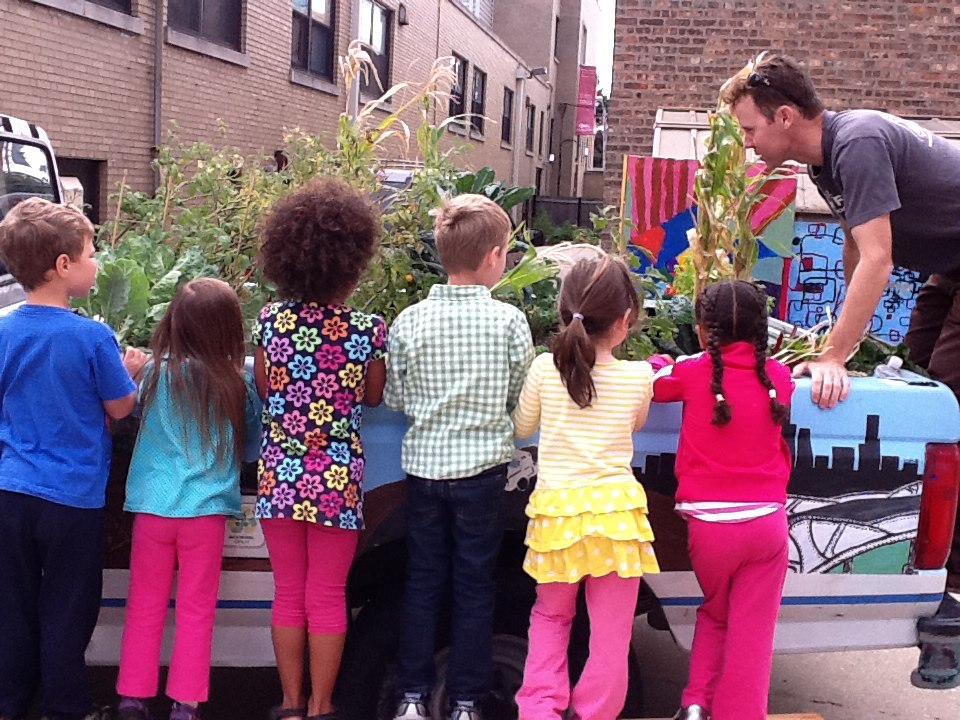
As a successful second season comes to a close, Truck Farm Chicago has passed out a lot of tomatoes! At almost every Truck Farm Chicago visit, truck farmers pass out freshly-picked tomatoes for people to taste.  After visiting more than 2,600 people at 60 sites over the 7 month season, that is over 2000 tomatoes! Quite a feat considering Truck Farm is a project directed and run just by one Chicago Health Corps AmeriCorps member, Sydney Weydemeyer and one Farmer Tim, with the help of a few wonderful volunteers and interns.
Truck Farm Chicago is a non-profit project of Seven Generations Ahead and Green Sugar Press. A mini farm planted in the bed of pickup truck named Petunia, Truck Farm engages both youth and adults in conversations about food and health. Truck Farm visits schools, libraries, park districts, businesses, community organizations and festivals teaching people about eating healthy, growing their own healthy food, and getting outside and staying active!
Kids trying tomatoes.
Farmer Tim at The Children's School in Oak Park discussing seed saving.


Combining numbers from the first and second seasons, Truck Farm Chicago has visited over 5,300 people in the Chicagoland area! Petunia's been all over the city, from Kilbourn Park Organic Greenhouse in Irving Park and Centers for New Horizons in Bronzeville, to Energy BBDO, Gary Comer Youth Center, Respiratory Health Association, the Kids Table, and countless Chicago schools. Truck Farm is small, but mighty!


For more information, or how you can bring Truck Farm to your school next season, visit www.truckfarmchicago.org.

Farmer Sydney, Chicago Health Corps member, sporting her AmeriCorps gear while leading a visit at Lloyd Elementary.
The kids at Centers for New Horizons give a big goofy thanks to our funder friends at Ernst & Young!
A girl laughs at a funny vegetable joke by Farmer Tim (one of the few laughs we got during the season for our veggie jokes)

Thursday, July 5, 2012

TurningPoint 2012—Sparking Service Nationwide

post written by Karen Berg, Chicago Health Corps Program Director

2012 Service Impact Awardees with the new CEO of the
Corporation for National and Community Service, Wendy Spencer (far right). 
My first experience with service was tutoring kindergartners at a Chicago Public School (CPS) elementary school when I was 13 years old.  Volunteering was part of my religious upbringing and that experience helped to shape my personal and professional commitment to improving social issues.  That was the first time I began to really understand disparities that exist in education, health and too many other facets of society.    Today I am encouraged and inspired by the organizations and individuals dedicated to service. 

Last week Chicago hosted the National Conference on Volunteering and Service, bringing together over 5,000 people who are passionate about national service and volunteering.  Over three days youth leaders, AmeriCorps members, program coordinators, volunteers and government leaders shared experiences and learned new ways to spark service and volunteerism across the country.  Notable speakers included First Lady Barbara Bush, Second Lady Dr. Jill Biden, IL Governor Pat Quinn, Chicago Mayor Rahm Emanuel, and Actor Kevin Bacon,

Lisa Joyner, PHC Program Director, heads up to the stage to accept the Service Impact Award.

Recognized at the conference was CHC’s sister program, the Philadelphia Health Corps (PHC), as a recipient of the Service Impact Award for Healthy Futures awarded by the Corporation for National and Community Service (CNCS).  My colleague Lisa Joyner was on hand to receive the award for PHC’s Prescription Assistance Programs.  PHC members help patients of Philadelphia’s District Health Centers to navigate through the complicated system of prescription assistance programs.  Members make sure patients get their medications while alleviating the cost burden to the city.  Over the past six years, the program has helped more than 12,646 patients gain free access to medications, saving the City of Philadelphia over $8.5 million. 

Service programs like Chicago and Philadelphia Health Corps play a valuable role in delivering services in communities where access disparities are inexcusable.  CHC members are serving to reduce disparities related to asthma, diabetes, cancer, HIV/STIs, and more.  CNCS’s grantee announcement was another time for CHC to celebrate at the conference.  The National Health Corps—comprised of Chicago, Philadelphia, Pittsburgh, North Florida and Atlanta—was awarded one of the 276 grants for 2012-13.   These grants will support 46,000 AmeriCorps members—including 16 in Chicago—serving coast to coast.

 Did you know 70% of people who volunteer do so because someone asked them to serve?  Share your first experience with service in the comments. 

Monday, June 25, 2012

From the Source: Neerja with American Cancer Society at Stroger Hospital

Another installment in our series about our members' service experiences, written in their own words.

John H. Stroger, Jr. Hospital of Cook County.
Formerly known simply as "Cook County Hospital."

One component of my term of service as an AmeriCorps member with the American Cancer Society at the John H. Stroger, Jr. Hospital of Cook County involves providing very basic case management services to patients referred to me by my supervisor, the ACS Clinical Navigator in Stroger’s Radiation Therapy Department.  A memorable case for me involved a patient who was already extremely ill and urgently needed medical equipment.  As a result, my supervisor asked me to try to expedite the approval of the patient’s Medicaid application.  The only information I had was the patient’s caseload number with the Department of Human Services, and the name of the her local DHS Office Administrator. 

I decided to start by calling the general Medicaid hotline number for Illinois.  Once I got past the automated information system to an actual person, I got the name and phone number of the patient’s caseworker, as well as the caseworker’s supervisor.  The caseworker told me that it wasn’t in her power to expedite the approval of a Medicaid application, and that an office in Springfield, Illinois was charged with that task.  She couldn’t give me the office’s phone number, but she gave me the office’s name and address. 

At that stage, I decided to take a chance by Googling the office’s name and address in the hopes that I would find a phone number for it.  Miraculously, I found a document that contained a name for an office that was similar to the one that the case worker had given me, as well as the name and phone number for a woman associated with that office.  I called her, and she told me that expediting Medicaid applications was a judgment call that each local DHS Office Administrator had to make.  She gave me the phone number for the patient’s local Office Administrator, and the application was eventually expedited. 

This whole process of calling various public agencies, being put on hold, and using Google took a day and a half.  While I was thrilled that I was able to get the patient’s Medicaid application expedited for approval, I was shocked and appalled that so many barriers were in place to prevent a sick patient from accessing insurance.  Indeed, I couldn’t imagine how a person who was already extremely ill, didn’t have a day and a half to spend on the phone, and didn’t have Internet access could possibly have succeeded in expediting his or her own Medicaid application. 

The experience made me incredibly appreciative of the existence of programs such as the American Cancer Society’s Patient Navigation Services, which assists patients in overcoming similar barriers to accessing care every day.  It also increased my resolve to practice medicine in an underserved community in the future so that I can work to prevent my future patients from developing such complex health conditions in the first place.  Most importantly, the experience of trying to identify and contact the exact individuals within the DHS who actually had the power to expedite the application reinforced for me the necessity of always looking at healthcare issues from the patient’s perspective.  Having learned that lesson, my goal both now and in the future as a physician is to eliminate as much confusion and uncertainty from their encounters with the healthcare system as possible.

Wednesday, May 30, 2012

From the Source: Savannah and Outside Service with Playworks

Another installment in our series where Chicago Health Corps members write about a service experience of their choice, in their own words

Dear Reader,
It is with great enthusiasm I write today about an organization dear to my heart. Playworks is a non-profit organization committed to inspiring safe, inclusive, and healthy physical activity in low-income schools across the country. In a Playworks school, students are active at recess, after school and in the classroom. The interaction is positive, accessible, and fun, in a way that enhances learning, teaches life skills, and promotes healthy living.
I have witnessed first-hand the developmental sports leagues directed by energetic Playworks coaches during after-school hours. These sports leagues allow students from any income level to learn the rules and skills necessary to be an athlete. Parents and student athletes gather for the evening games, proud to represent their schools. The score of the game is not kept. The focus is entirely on learning the game, building character, and having fun. The atmosphere is electric and light-hearted. Parents and players are cheering for both teams, indiscriminately. Most touching, in my view, was seeing the children, during time-outs and after the game, being prompted by coaches to share the positive things they saw their teammates doing on the court. No one was placing blame. The focus was around what the team was doing right. There is also a rare breed of sportsmanship taking place on the court. Sometimes, with 5 minutes until game time, a team would be short 2 or 3 players, and without fail, members of the other team were volunteering to help balance the teams, trading out their jerseys, smiling and learning the names of the other school’s players, and the game goes on.
For me Playworks is a vision of what all schools in America can and perhaps should be. Not a place where physical education is slipped in, grudgingly for some, merely to meet federal requirements. Not a place where recess is a distraction and a springboard for behavior issues which then spill into the classroom. In a Playworks school there is an authentic incorporation of play into the life of the student. Here young people are appreciating that physical activity is an enjoyable part of their life style not an unwelcome and disorganized ritual. A healthy relationship with playing and learning is what perpetuates my deep respect for Playworks, their mission and method, and is the reason I hope to continue volunteering with Playworks in the years to come. I invite anyone who is similarly impressed by the good work of Playworks to join their volunteer team and we’ll see you at the next game!
-Savannah Jackson


Below are photos of three Chicago Health Corps members, volunteering at the recent Playworks Chicago Volleyball Extravaganza. This event kicked off the co-ed volleyball season for the Playworks schools in the city. Everyone had a great time bumping, setting, spiking, and serving! Go Playworks!


Coach Becca creates safety in a drill where students practice
 good control by trying to hit the cones.


The players are practicing their very best bumping with Coach Savannah.


Coach James catches a loose ball as students practice aiming their serves toward the basketball hoop.


Monday, May 21, 2012

From the Source: Nina at Erie Family Health Center--Humboldt Park


     Once a month, Erie Family Health Center--Humboldt Park offers a class called Diabetes Mes por Mes. Diabetes Mes por Mes is a great way to give people with diabetes the opportunity to learn more about their disease and management strategies, gain support, and share common frustrations. All classes are held in Spanish. So far, we have covered the following topics: nutrition, mental health, staying healthy during the holidays, and traveling safely with diabetes. We make sure to give patients simple ways to achieve better health. For example, we taught an entire class devoted to healthy cooking tips. We showed patients how to cook a variety of vegetables and demonstrated portion sizes. In addition, we discussed healthy flavoring alternatives to salt and outlined healthy recipes. To demonstrate that cooking healthy can be easy and tasty, we cooked a vegetable soup for each patient to sample. Each patient went home with a healthy recipe packet.

      Since October 2011, Diabetes Mes por Mes attendance has doubled. There are 80 participants who have attended one or more classes. Each month more and more patients are referred into the program. We hope to continue to expand the group and find creative ways to help patients understand diabetes and practice healthy disease-management strategies.

Wednesday, May 2, 2012

From the Source: Truck Farm Chicago with Farmer Sydney

A series of posts where Chicago Health Corps members write candidly about their service experiences.


Farmer Sydney here from Truck Farm Chicago! Farmer Tim, Farmer Shari, and I have been working to get Truck Farm Chicago back on the road for the past 5 months and what a journey it has been . . . Recruiting and organizing volunteers, scheduling school visits, writing many failed grants, and tracking down plants and compost and the season has only just begun (literally, season started last Monday)!
After dead batteries, flying-away hoop houses on Highway 94 (a mini greenhouse-like enclosure we put on the back of the truck to protect the plants), our movie-maker deciding to stay in the Philippians were he was visiting, a hacked website, and a spiffy new paint job, Truck Farm Chicago is back on the road! Keep your eyes out for a roaring engine, bright blue paint job, a truck filled with tiny baby plants, and happy farmers throwing vegetables out the window to gawking children.


One day soon our truck will look like this!


Wednesday, April 25, 2012

From the Source: Sana at the Westside Health Authority

Introducing something new from the Chicago Health Corps. We are starting a new series of posts, entitled "From the Source," which will feature a member's writings about a personal service experience during their time in the CHC. Up to this point many of the blog posts have been about our large service projects, trainings, or events, and our everyday service has taken a back seat. Well no longer! Enjoy our "From the Source," posts as they highlight the diverse experiences of our Corps members. This inaugural post comes from Sana Syal, serving at the Westside Health Authority.

Sana teaches students how the nutrients in foods benefit our bodies.
        A large part of my service position involves facilitating nutrition classes in 3 elementary schools and 2 Head Start centers.  With the elementary school sites, we use Seven Generations Ahead’sFresh from the Farm” curriculum, in which each lesson is dedicated to a specific fruit or vegetable.  Students learn about how the fruit or vegetable is grown, where it’s grown, and what nutrients they have that benefit our bodies.  One of our first classes was all about squash, including tasting raw squash. Many students hadn’t heard of squash before, and when they saw the raw cubes of butternut squash, many thought it was cheese. To their surprise, they liked the squash, especially the pieces we soaked in apple juice and cinnamon!
            At the Head Start centers, the curriculum we use focuses on food identification and food tasting.  The children have participated in a variety of activities, including “going” to a mock supermarket to pick out healthy foods, creating a fruit clown face, and guessing what fruit or vegetable is inside a mystery bag.
            Being with the students and learning together about healthy food has been an incredibly rewarding experience – their enthusiasm is contagious, and they teach me something new every time I see them!  The students look forward to our classes too, and it’s always nice to hear the kids scream “yes!” whenever we enter the school.

Sana passes around squash to the eager students.
Testing the tasty squash as part of the "Fresh from the Farm" curriculum


Giving blueberries a try.

Tomatoes! Whoa!

Whaddaya know? These kids love squash.

Very carefully tasting the mystery squash.


Sana with Head Start students.


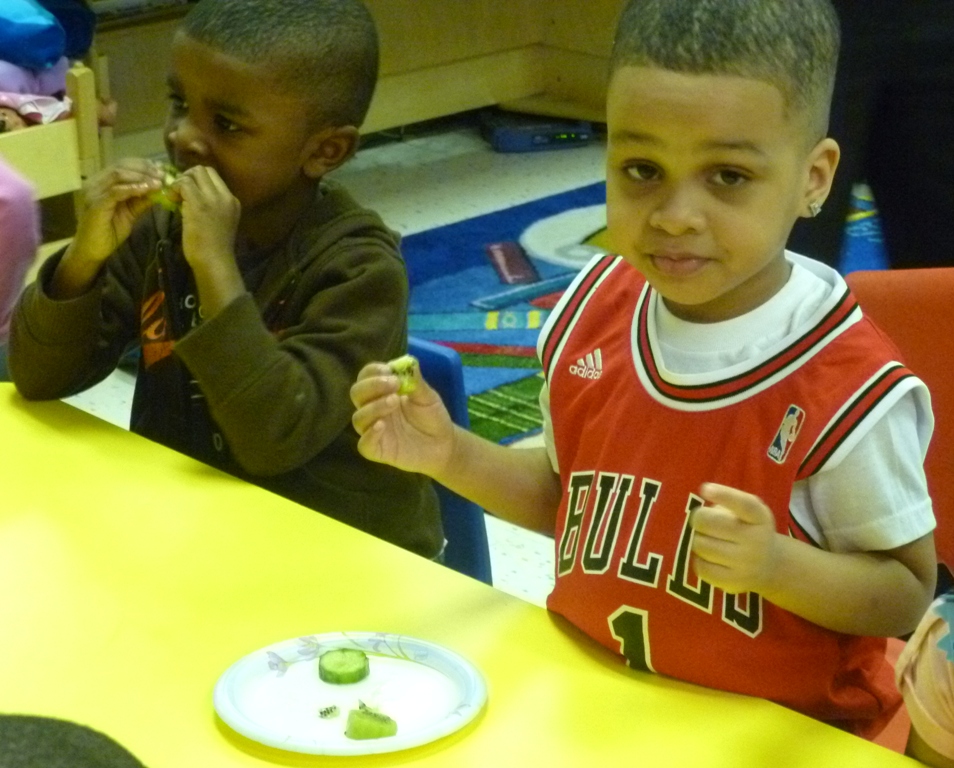
Go Bulls! Go Cucumbers!


Farmer Sydney issues a well-deserved high five

Pondering the melon.


Storytime is the best time

Matt laying down the food knowledge.


Funny fruit clown faces!


Three- and four-year-olds learning about oregano? These kids are going to be food geniuses!