Showing posts with label Member Experiences. Show all posts

Wednesday, April 17, 2013

The Boston Marathon...


Post written by CHC member Daniel Broome

Daniel serves at the American Cancer Society at Stroger Hospital as a Patient Navigator


The Bombing of Boston that took place on Monday, April 15th 2013, at the site of the Marathon finish line was a terrible and heart-wrenching event.  Many of us with friends or family in Boston were relieved to hear the confirmed safety of our loved ones. We also felt the loss of the three victims whose lives were lost in what is usually a monumental celebration of health and determination, the Boston Marathon.
Photo Credit: New York Times

Despite the two explosions, the three fatalities, and the nearly two hundred injured, we still celebrate the champions from Monday. According to the Boston Athletic Association:
17,580 people completed the marathon.
686 people between the ages of 60-69,
27 people between the ages of 70-79,
1 man over the age of 80,
And everyone in a wheelchair and in a hand-cycle completed the 2013 Boston Marathon.


Though much of the coverage of the bombing highlights the explosions and the damage done, today the stories that are being told are of the bystanders who responded immediately to assist and aid the wounded. 
It is unfortunate to see such evil being done to innocent people, but it is inspiring to see what good people are capable of doing when they work together.
 
Photo Credit: The Gaudian
Times like this remind us how public health is involved in every aspect of our lives. It is an overarching umbrella whose mission is to consider the well-being of all people and all that could threaten that well-being. As members of Chicago Health Corps and its sister AmeriCorps program, the Healthy Communities Corps, we are all united by a common altruism, a common spirit and a shared belief that helping people become healthier will make a positive difference in peoples’ lives. In the midst of this tragedy, we stand alongside and honor the runners, their families and all those who rushed to help and celebrate their great endurance, their great achievements, and their great bravery during the Boston Marathon.

We hope to see a record number of participants in the 2014 Boston Marathon!


Friday, March 15, 2013

AmeriCorps – The Second Time Around


Post written by CHC member Maggie Sugrue


Maggie serves at the ErRespiratory Health Association as a Lung Educator


In honor of National AmeriCorps week, I spent some time reflecting on what service has meant to me. Chicago Health Corps is not my first experience with service- last year I served with the Jesuit Volunteer Corps Northwest in Juneau, Alaska. Both of these experiences were transformative for me in many different ways.

Maggie with her 6 housemates in Juneau, Alaska. (April, 2012)
Last year, I was able to impact a community much different than one I had ever experienced before. I learned a lot not only professionally, but personally as well. Living in Alaska thousands of miles from home, adapting to a new culture, and living in a house with other volunteers made me much stronger in my convictions and cultivated my sense of self. JVC NW is based on living out four core values. Two of these values, community and simple living, I found both the most challenging and most rewarding.  When living in an intentional community with 6 other volunteers, each person’s opinion is taken into account for every decision made, ranging from something as small as which type of milk to buy to as large as where to live. This shared living experience combined with the lack of modern conveniences, such as TV and internet, provided me with many opportunities for growth. I learned the art of compromise, when to stick up for my beliefs, when to step up and take a leadership role, and what truly matters in life.

Joining Chicago Health Corps brought me back home, where I am able to apply what I learned during my service in Alaska, and continue to build on it here in my own community. Serving in the city I grew up in is an honor, and making a difference in a place I call home is something I have always wanted to do. I serve as a Lung Health Educator at Respiratory Health Association, a non-profit that promotes healthy lungs and fights lung disease through research, advocacy and education. This experience, has given me the opportunity to refine my leadership skills, build connections, and most importantly, learn more from those I serve than they may even learn from me. Service has been a once, ok twice, in a lifetime opportunity that will shape the path my life will take. It has solidified my passion for both public health and public service, and I cannot imagine where I would be without it.

Respiratory Health Associations COPD Team at the
 2012 Living Better Together COPD Conference
(Photo Courtesy of Sooz Main)

Monday, March 11, 2013

CHC has a YouTube Channel!

We now have a YouTube Channel!  You're excited?  I know, we are too.  


Click HERE to watch video bios of ALL of our members! 

SUBSCRIBE TO OUR CHANNEL FOR THE MOST RECENT VIDEO POSTS

Just for a taste here is our lovely Abbey Baus talking about her service... Check it out!


For direct links to individual bios go to Our Current Members page.

AmeriCorps* Love


Tuesday, February 19, 2013

Serving a Balanced Education – CVCA’s Food Education Program


Post written by CHC member Chinwe Ntamere

Chinwe serves with the American Cancer Society as a Health Educator


The National School Lunch Program was introduced in 19461 as a program that provides breakfast and lunch to children who may otherwise have nothing to eat.  It has become the second largest food program in the U.S., spending $8 billion annually and feeding an average of 30 million children a day1,2. Recently, some have argued that it lacks in both education and nutritional benefits, citing recent studies linking school lunches with a higher risk of obesity3,4,5.

At a recent in-service day, Chicago Health Corps and Healthy Communities Corps visited the Chicago Vocational Career Academy (CVCA), where educators promote healthier student lunches, while also expanding student career options. As part of the Chicago Public Schools’ Culinary and Hospitality Career and Technical Education Program, students have the opportunity to gain food service certification and food preparation experience while in school. Students take an active part in creating school lunches that meet their taste, while fitting within the school’s nutritional and budgetary requirements. These are skills that the students can transfer to their own lives, encouraging them to actively think about the role of food in their own health.

David Blackmon, the Executive Director of the CPS Culinary Arts and Hospitality Program, argues that more programs like these should be offered to students, especially in lower income communities where access to healthy foods and job opportunities are limited. By providing students with career skills before college, they have the option of either entering the work world directly after graduation or entering college with a better understanding of what career path they want to follow.

At the Chicago Vocational Career Academy, they believe that all elements of the school day, whether it is the curriculum or lunch menu, should provide the students with tangible life skills. By encouraging active student participation in lunch preparation, they have empowered students to take control of their own health and nutrition, ensuring there are educational opportunities in the debated school lunch program.

1.      Committee on Nutrition Standards for National School Lunch and Breakfast Programs, National Research Council. (2008). Nutrition Standards and Meal Requirements for National School Lunch and Breakfast Programs: Phase I. Proposed Approach for Recommending Revisions. (V. A. Taylor, Ed.) Institute of Medicine of the National Academies. From NAP: http://www.nap.edu/catalog/12512.html
2.      Black, J. (2011, February 24). School Lunch Is Not the Answer: Improving school food is only a small step toward reducing childhood obesity. Retrieved February 9, 2013, from Slate: http://hive.slate.com/hive/time-to-trim/article/school-lunch-is-not-the-answer
3.      RABIN, R. C. (2011, February 4). Childhood: Obesity and School Lunches. Retrieved February 9, 2013, from New York Times: http://www.nytimes.com/2011/02/08/health/research/08childhood.html?_r=0
4.      Millimet, D., Tchernis, R., & Husain, M. (2010). School Nutrition Programs and the Incidence of Childhood Obesity. Journal of Human Resources , 45 (3), 640-645.
5.      Park, E., & Graziano, M. (Directors). (2010). Lunch Line [Motion Picture]. United States: UJI Films. From UJI Films: http://lunchlinefilm.com/

Tuesday, November 27, 2012

Public Transportation as a View into Public Health in Chicago


Post written by CHC member Jenny Carson

Jenny is serving as a Colorectal Cancer Screening Health Educator with the  American Cancer Soceity's Statewide Colorectal Cancer Screening Initiative


 Serving as a Chicago Health Corps member, I feel a commitment to better understand the vast communities and cultures that make up the social fabric of the Chicago Metropolitan area.  Since moving to Chicago, I read about the history of Chicago’s neighborhoods, in order to better understand why “the neighborhood effect” and disparities continue to exist.  The conditions of each neighborhood have major effects on that community, impacting mortality and chronic disease rates, health behaviors, and violence. 

One of the most apparent, yet often overlooked, public health challenges can be observed during my daily commute. I witness how neighborhoods shape behaviors and influence the health of the diverse population getting on and off public transit. I wrote a sequence of words that describe what I see out my window on my daily commute as I move  from a Chicago northwest neighborhood off the CTA Blue Line to the free clinic I serve at off the green line in a Chicago southwest neighborhood. 

Coffee steam, Hipsters, glassesNewspapers, Greek Yogurt, Pea coats, scarves, brief cases, Students, human sardines, tunnels, escalators, stairs,pigeons,my watch, head phones, Bulls hat, Hip-Hop, Dunkin Donuts, trackssss, feel the sway, skyline, U.S. Cellular Field, my skin color, FlaminHots, grocery store?, corner stores, strollers, Cop Cars, parking lots, security guards, sliding doors. . .  Medical Home      

The health of a community starts with an assessment of how the physical, social, and service environment of the neighborhood affects health behaviors. The physical environment of a neighborhood, which includes the “built environment” (i.e. infrastructure) and natural environment (i.e. trees, flowers), combined with the social environment (i.e. relationships among residents), affects the neighborhood residents’ health risks and behaviors. For example, pollution and high crime rates in a neighborhood often leads to low exercise rates, increased drug and alcohol use, and lack of healthy role models.  A neighborhood’s service environment, including availability of employment, good schools, and transportation resources, can affect whether residents smoke, have healthy diets, and practice safe sex.

HEALTH is all around us, including much more than feeling ill and trying to exercise.  The next time you commute, or simply sit in a public space, look up and take in your environment.  In order to preserve the health of future populations, we must change our daily behaviors and evaluate the health of every community with a holistic assessment.  What will you notice?  

For more information on the neighborhood effect in Chicago, check out this book from the University of Chicago press “The Great American City: Chicago and the enduring neighborhood effect.”

Projects such as the Smart Chicago Collaborative: Chicago Health Atlas will help us evaluate communities to improve care.
Also check out a study of 77 of Chicago’s Neighborhoods conducted by Northwestern University Feinberg School of Medicine, in collaboration with Chicago Department of Public Health and Aetna, Inc., documenting the health of residents and resources in Chicago neighborhoods.   

Thursday, November 1, 2012

The Spooky Truth


Post written by CHC member Amber Adams:
It is November 1st and American households are now stocked with candy treats, costumes are tucked away, and the haunted and scary festivities for this holiday season have come to an end. However, for many individuals seen at Heartland Health Center’s Wilson Clinic, the reality of “spooky” and scary truths, such as intimidating doctor visits, frustrations due to the inability to understand health information, and confusing procedures and diagnoses, extends well past the Halloween holiday.  
Many of the individuals seen at Heartland Health Center’s Wilson clinic are refugees. While fleeing their homelands in pursuit of safety, they immediately undergo a strenuous resettlement process upon arrival to the U.S. Within the first 30 days, refugees are required to complete a number of tasks to promote self-sufficiency and cultural adjustment, including learning to speak English.
Due to language barriers and differences in culture, many refugees need interpretation and further explanation concerning their medical care. My service term with Heartland Health Centers provides me the opportunity to assist with this need. I offer 1-on-1 nutrition counseling to patients and create cultural competency and health literacy tools to address some of the complicated health procedures and diagnoses for Wilson’s diverse patient population. Most refugees in Chicago come from Burma, Bhutan, Iraq, Somalia, Ethiopia and Afghanistan, according to the Heartland Alliance. 
To no surprise, with the cultural shock and overwhelming tasks refugees’ transition, grocery shopping for low-calorie foods or making sure to get all 5 food groups in with each meal may fall lower on their priority list.  However, the shocking reality that some patients do not understand health information and instructions given by physicians, and that information is so easily misinterpreted or lost in translation, makes my service an essential part of making sure our patients have access to the necessary healthcare information.
While I enjoy thinking up the perfect Halloween costume and anticipating the reaction to what I’ve brought to life another year, I’m glad my creativity is not limited to just this holiday season.  With much excitement and pleasure, I am able to design health educational tools, bulletin boards, and provide culturally competent resources that patients can read, understand, and act on concerning their health. This makes me proud, humbled, and happy to serve.

“The true way to render ourselves happy is to love our work and find in it our pleasure”
-Francoise de Motteville


Monday, June 25, 2012

From the Source: Neerja with American Cancer Society at Stroger Hospital

Another installment in our series about our members' service experiences, written in their own words.

John H. Stroger, Jr. Hospital of Cook County.
Formerly known simply as "Cook County Hospital."

One component of my term of service as an AmeriCorps member with the American Cancer Society at the John H. Stroger, Jr. Hospital of Cook County involves providing very basic case management services to patients referred to me by my supervisor, the ACS Clinical Navigator in Stroger’s Radiation Therapy Department.  A memorable case for me involved a patient who was already extremely ill and urgently needed medical equipment.  As a result, my supervisor asked me to try to expedite the approval of the patient’s Medicaid application.  The only information I had was the patient’s caseload number with the Department of Human Services, and the name of the her local DHS Office Administrator. 

I decided to start by calling the general Medicaid hotline number for Illinois.  Once I got past the automated information system to an actual person, I got the name and phone number of the patient’s caseworker, as well as the caseworker’s supervisor.  The caseworker told me that it wasn’t in her power to expedite the approval of a Medicaid application, and that an office in Springfield, Illinois was charged with that task.  She couldn’t give me the office’s phone number, but she gave me the office’s name and address. 

At that stage, I decided to take a chance by Googling the office’s name and address in the hopes that I would find a phone number for it.  Miraculously, I found a document that contained a name for an office that was similar to the one that the case worker had given me, as well as the name and phone number for a woman associated with that office.  I called her, and she told me that expediting Medicaid applications was a judgment call that each local DHS Office Administrator had to make.  She gave me the phone number for the patient’s local Office Administrator, and the application was eventually expedited. 

This whole process of calling various public agencies, being put on hold, and using Google took a day and a half.  While I was thrilled that I was able to get the patient’s Medicaid application expedited for approval, I was shocked and appalled that so many barriers were in place to prevent a sick patient from accessing insurance.  Indeed, I couldn’t imagine how a person who was already extremely ill, didn’t have a day and a half to spend on the phone, and didn’t have Internet access could possibly have succeeded in expediting his or her own Medicaid application. 

The experience made me incredibly appreciative of the existence of programs such as the American Cancer Society’s Patient Navigation Services, which assists patients in overcoming similar barriers to accessing care every day.  It also increased my resolve to practice medicine in an underserved community in the future so that I can work to prevent my future patients from developing such complex health conditions in the first place.  Most importantly, the experience of trying to identify and contact the exact individuals within the DHS who actually had the power to expedite the application reinforced for me the necessity of always looking at healthcare issues from the patient’s perspective.  Having learned that lesson, my goal both now and in the future as a physician is to eliminate as much confusion and uncertainty from their encounters with the healthcare system as possible.

Wednesday, June 6, 2012

The Tilden Cancer Screening Project with Neerja

post written by CHC member, Neerja J.
A few weeks ago, I met with the Teen Outreach Program Facilitator for a homeroom class at Tilden Career Community Academy in Chicago’s Back of the Yards neighborhood.  Her class needed to do a service project to fulfill part of their graduation requirements, and they voted to do their project on cancer screenings in their community.  Since I was serving with the American Cancer Society, the Facilitator asked for my help in creating resource guides on free and low-cost cancer screenings available in the Back of the Yards, Bridgeport, Chinatown, and Englewood neighborhoods (where most of the students lived). 

I spent the next few weeks researching health clinics in these neighborhoods, as well as their billing systems and the types of medical services they offered.  I also plotted out bus routes between the neighborhoods and the clinics to make sure that the latter were easily accessible and would not require residents to stray too far outside of their own neighborhoods.  Finally, I also found educational materials on cancer screenings, and conversation models to help the students talk to their parents about the importance of screenings. 

I put all of the clinical information into the resource guides, and also created a presentation for the students on different types of cancer screenings, their importance, and where they could be done within their own communities.  Despite some technical difficulties, I had the chance to present that information to two classes at Tilden on May 10th and 11th.  I was impressed with how much the students already knew about cancer and screening methods, and I loved having the chance to answer the questions that they did have.  All in all, I enjoyed having the chance to interact with students and to serve outside of a hospital setting (I can’t even begin to describe what a change of pace it was from Stroger!) 

Wednesday, May 30, 2012

From the Source: Savannah and Outside Service with Playworks

Another installment in our series where Chicago Health Corps members write about a service experience of their choice, in their own words

Dear Reader,
It is with great enthusiasm I write today about an organization dear to my heart. Playworks is a non-profit organization committed to inspiring safe, inclusive, and healthy physical activity in low-income schools across the country. In a Playworks school, students are active at recess, after school and in the classroom. The interaction is positive, accessible, and fun, in a way that enhances learning, teaches life skills, and promotes healthy living.
I have witnessed first-hand the developmental sports leagues directed by energetic Playworks coaches during after-school hours. These sports leagues allow students from any income level to learn the rules and skills necessary to be an athlete. Parents and student athletes gather for the evening games, proud to represent their schools. The score of the game is not kept. The focus is entirely on learning the game, building character, and having fun. The atmosphere is electric and light-hearted. Parents and players are cheering for both teams, indiscriminately. Most touching, in my view, was seeing the children, during time-outs and after the game, being prompted by coaches to share the positive things they saw their teammates doing on the court. No one was placing blame. The focus was around what the team was doing right. There is also a rare breed of sportsmanship taking place on the court. Sometimes, with 5 minutes until game time, a team would be short 2 or 3 players, and without fail, members of the other team were volunteering to help balance the teams, trading out their jerseys, smiling and learning the names of the other school’s players, and the game goes on.
For me Playworks is a vision of what all schools in America can and perhaps should be. Not a place where physical education is slipped in, grudgingly for some, merely to meet federal requirements. Not a place where recess is a distraction and a springboard for behavior issues which then spill into the classroom. In a Playworks school there is an authentic incorporation of play into the life of the student. Here young people are appreciating that physical activity is an enjoyable part of their life style not an unwelcome and disorganized ritual. A healthy relationship with playing and learning is what perpetuates my deep respect for Playworks, their mission and method, and is the reason I hope to continue volunteering with Playworks in the years to come. I invite anyone who is similarly impressed by the good work of Playworks to join their volunteer team and we’ll see you at the next game!
-Savannah Jackson


Below are photos of three Chicago Health Corps members, volunteering at the recent Playworks Chicago Volleyball Extravaganza. This event kicked off the co-ed volleyball season for the Playworks schools in the city. Everyone had a great time bumping, setting, spiking, and serving! Go Playworks!


Coach Becca creates safety in a drill where students practice
 good control by trying to hit the cones.


The players are practicing their very best bumping with Coach Savannah.


Coach James catches a loose ball as students practice aiming their serves toward the basketball hoop.


Monday, May 21, 2012

From the Source: Nina at Erie Family Health Center--Humboldt Park


     Once a month, Erie Family Health Center--Humboldt Park offers a class called Diabetes Mes por Mes. Diabetes Mes por Mes is a great way to give people with diabetes the opportunity to learn more about their disease and management strategies, gain support, and share common frustrations. All classes are held in Spanish. So far, we have covered the following topics: nutrition, mental health, staying healthy during the holidays, and traveling safely with diabetes. We make sure to give patients simple ways to achieve better health. For example, we taught an entire class devoted to healthy cooking tips. We showed patients how to cook a variety of vegetables and demonstrated portion sizes. In addition, we discussed healthy flavoring alternatives to salt and outlined healthy recipes. To demonstrate that cooking healthy can be easy and tasty, we cooked a vegetable soup for each patient to sample. Each patient went home with a healthy recipe packet.

      Since October 2011, Diabetes Mes por Mes attendance has doubled. There are 80 participants who have attended one or more classes. Each month more and more patients are referred into the program. We hope to continue to expand the group and find creative ways to help patients understand diabetes and practice healthy disease-management strategies.

Wednesday, May 9, 2012

Jessica Takes Students from Orozco Elementary to Free Eye Clinic

Did you know that May is Healthy Vision Month!? We didn't either until we Googled it! To celebrate this special occasion we are featuring a special post from CHC member, Jessica Torres.


One component of my service position is to coordinate vision screenings and vision exams for students at Orozco.  I then assist students who failed their eye exam receive free glasses. With the help of the Chicago Public School Office of Special Education and Specials we are able to make this all possible.

On Monday April 23rd, an optometrist from Ageless Eye Care visited Orozco and provided 21 students with free eye exams and glasses if needed. The Thursday of that same week, we loaded up a school bus full of 34 Orozco students and traveled to the Princeton Clinic on the southside of Chicago. Here all students traveled from room to room getting their little eyeballs examined. In total 55 students were given free eye exams and more than half picked glasses frames and will receive free glasses in 4-6 weeks! 

One of my favorite parts of this project? Convincing kids that glasses cool! Throughout the week of April 23rd-27th  I had a number of conversations with students on the “coolness” of wearing glasses.

One specifically went like this:
“Uhhh Ms. Jessica I don’t want glasses, they just aren’t cool!”
“What are you talking about? I wear glasses.”
“Well I’ve never SEEN you in them.”
“Hahaha, fine. I’ll wear them everyday once you guys get yours. Deal?”
“Deal.”

So in 4-6 weeks when we receive a box full of glasses I’ll have to keep up my end of the deal and roam the school in my glasses just like all the other cool kids :)


Friday, May 4, 2012

Chicago Health Corps Connects with the Lakeview Food Pantry

Post by CHC member, Rebecca M.


Right between the boisterous Wrigley Field and the affluent Lincoln Park neighborhood of Chicago, you find the Lakeview Food Pantry. Opening in 1970 part of the pantry’s’ mission is to “increase the independence of our clients through self-help initiatives and other innovative programs.”  Chicago Health Corps members have facilitated this initiative by providing health education sessions since January.
After serving at their host sites during the day, members traveled to the pantry and taught sessions for clients there every Wednesday evening.  The sessions ranged from a variety of topics like sexual and reproductive health, diabetes, asthma, and smoking cessation.  During these sessions the clients were empowered to make healthy lifestyle changes.  And healthy changes were made by two clients who were able to quit smoking after Danielle Nelson, a CHC member, facilitated a smoking cessation class/support group.
Members learned as much as the clients did while teaching the sessions.  While in the pantry, challenges such as food scarcity and other needs of the clients were apparent.  The basic needs of the clients would not have been met had the Lakeview Pantry not been there to offer assistance.  They offer home deliveries to clients, a choice market where clients can choose the food they want and specialty diabetic and heart healthy bags for patrons.
As a CHC volunteer said, “Spending time at the Lakeview Food Pantry has been an overwhelmingly positive experience.  The staff works to improve the lives of their clients who come in for food, but walk out with warm clothes, a full stomach, and feeling good about themselves.”  We are grateful for the opportunity with the pantry to assist an important agency within our community.


Wednesday, May 2, 2012

From the Source: Truck Farm Chicago with Farmer Sydney

A series of posts where Chicago Health Corps members write candidly about their service experiences.


Farmer Sydney here from Truck Farm Chicago! Farmer Tim, Farmer Shari, and I have been working to get Truck Farm Chicago back on the road for the past 5 months and what a journey it has been . . . Recruiting and organizing volunteers, scheduling school visits, writing many failed grants, and tracking down plants and compost and the season has only just begun (literally, season started last Monday)!
After dead batteries, flying-away hoop houses on Highway 94 (a mini greenhouse-like enclosure we put on the back of the truck to protect the plants), our movie-maker deciding to stay in the Philippians were he was visiting, a hacked website, and a spiffy new paint job, Truck Farm Chicago is back on the road! Keep your eyes out for a roaring engine, bright blue paint job, a truck filled with tiny baby plants, and happy farmers throwing vegetables out the window to gawking children.


One day soon our truck will look like this!


Wednesday, April 25, 2012

From the Source: Sana at the Westside Health Authority

Introducing something new from the Chicago Health Corps. We are starting a new series of posts, entitled "From the Source," which will feature a member's writings about a personal service experience during their time in the CHC. Up to this point many of the blog posts have been about our large service projects, trainings, or events, and our everyday service has taken a back seat. Well no longer! Enjoy our "From the Source," posts as they highlight the diverse experiences of our Corps members. This inaugural post comes from Sana Syal, serving at the Westside Health Authority.

Sana teaches students how the nutrients in foods benefit our bodies.
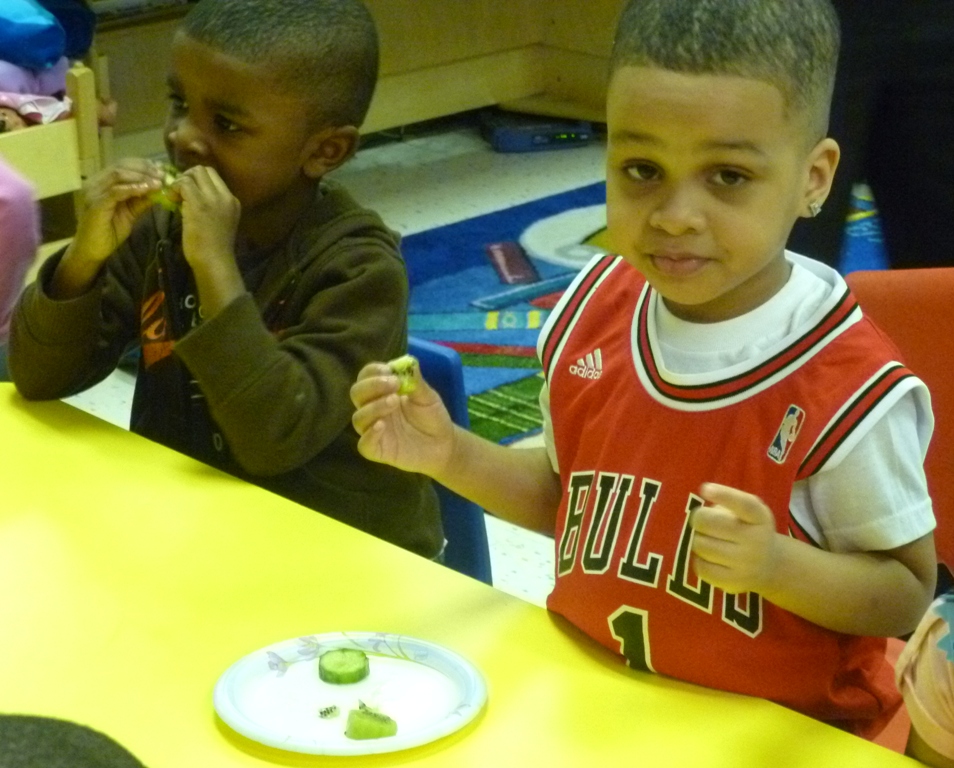
        A large part of my service position involves facilitating nutrition classes in 3 elementary schools and 2 Head Start centers.  With the elementary school sites, we use Seven Generations Ahead’sFresh from the Farm” curriculum, in which each lesson is dedicated to a specific fruit or vegetable.  Students learn about how the fruit or vegetable is grown, where it’s grown, and what nutrients they have that benefit our bodies.  One of our first classes was all about squash, including tasting raw squash. Many students hadn’t heard of squash before, and when they saw the raw cubes of butternut squash, many thought it was cheese. To their surprise, they liked the squash, especially the pieces we soaked in apple juice and cinnamon!
            At the Head Start centers, the curriculum we use focuses on food identification and food tasting.  The children have participated in a variety of activities, including “going” to a mock supermarket to pick out healthy foods, creating a fruit clown face, and guessing what fruit or vegetable is inside a mystery bag.
            Being with the students and learning together about healthy food has been an incredibly rewarding experience – their enthusiasm is contagious, and they teach me something new every time I see them!  The students look forward to our classes too, and it’s always nice to hear the kids scream “yes!” whenever we enter the school.

Sana passes around squash to the eager students.
Testing the tasty squash as part of the "Fresh from the Farm" curriculum


Giving blueberries a try.

Tomatoes! Whoa!

Whaddaya know? These kids love squash.

Very carefully tasting the mystery squash.


Sana with Head Start students.


Go Bulls! Go Cucumbers!


Farmer Sydney issues a well-deserved high five

Pondering the melon.


Storytime is the best time

Matt laying down the food knowledge.


Funny fruit clown faces!


Three- and four-year-olds learning about oregano? These kids are going to be food geniuses!